


Your lab results land in the patient portal, and one line is flagged: total bilirubin, 1.6 mg/dL. Everything else looks fine. Now you're squinting at a word you've never had to think about, wondering whether your liver is trying to tell you something.
Take a breath. Bilirubin is one of the most common lines on a routine blood panel, and a slightly high number has many explanations, several of them completely harmless. It's also a genuinely useful window into what your liver does every day, because clearing bilirubin is one of its jobs.
In this guide we'll cover what bilirubin is, the trip it takes through your body, how to read direct and indirect results, what normal looks like, why levels run high, and when a high number needs a closer look. Let's dive in!
Key takeaways
- Bilirubin is a yellowish pigment made when your body breaks down old red blood cells, and your liver clears it into bile.
- A common normal range for total bilirubin is about 0.1 to 1.2 mg/dL, though every lab sets its own range.
- High levels can come from extra red blood cell breakdown, a liver that's struggling to process bilirubin, or blocked bile flow.
- Gilbert syndrome, a mild inherited trait that affects an estimated 3 to 7 percent of Americans, is a common and usually harmless reason for a slightly high result.
What is bilirubin?
Bilirubin is a yellowish substance your body makes during the normal process of breaking down old red blood cells, and it's found in bile, the digestive fluid your liver produces (1). It's the pigment that gives bile its yellow color, and it's also what colors your poop (2).
More specifically, bilirubin forms when hemoglobin, the oxygen-carrying part of your red blood cells, is broken down as part of the body's routine recycling of old or damaged cells (3). So every day, a steady stream of it is made, sent to your liver and passed out of your body. When that stream backs up, you see it in your blood test, and sometimes in your skin and eyes.
How your liver handles bilirubin, step by step
Think of it as a relay race with your liver running the most important leg:
- Old red blood cells break down. Hemoglobin is recycled and bilirubin is released into the bloodstream (3).
- It hitches a ride to the liver. In this first form it doesn't dissolve in water, so it travels bound to a blood protein called albumin (2).
- Your liver converts it. An enzyme in liver cells, bilirubin-UGT, attaches a compound called glucuronic acid. That makes bilirubin water-soluble so the body can get rid of it (4).
- It leaves with bile. The converted bilirubin mixes into bile, flows through the bile ducts and into your intestines (2).
- It exits in your stool. Most of it leaves the body this way, which is where stool gets its color (2).
Every step can slow down: too much bilirubin made at the start, a liver that can't keep up in the middle, or a blocked duct at the end. That three-part picture is the key to reading a high result.
Direct vs indirect bilirubin on your lab report
Your report may show up to three bilirubin numbers, and they map onto that relay race (2):
- Indirect (unconjugated) bilirubin. The form on its way to the liver, not yet processed. Labs usually can't measure it directly, so they calculate it by subtracting direct from total.
- Direct (conjugated) bilirubin. The form your liver has already processed, now able to dissolve in water and leave in bile.
- Total bilirubin. The two added together, and the number most routine panels report.
Why does the split matter? It points your doctor toward the step where things slowed down. Higher indirect bilirubin can mean red blood cells are breaking down faster than the liver can keep up, higher direct bilirubin points toward trouble clearing it, such as bile duct or gallstone problems, and conditions that affect the liver's processing can raise both (2).
What normal bilirubin levels look like
It's normal to have some bilirubin in your blood. MedlinePlus lists these typical adult ranges (5):
- Total bilirubin: 0.1 to 1.2 mg/dL (1.71 to 20.5 micromol/L)
- Direct bilirubin: less than 0.3 mg/dL (less than 5.1 micromol/L)
Ranges vary from lab to lab, and Cleveland Clinic gives 0.2 to 1.3 mg/dL as the usual normal total for children and adults (2). That's why your report's own reference range beats any number you find online, including ours. Visible yellowing of the skin or eyes, called jaundice, can appear at around 2.0 mg/dL (5).
Reading a borderline result
A total of 1.4 or 1.6 mg/dL sits just above many labs' upper limit. On its own it's a reason to look at the rest of your panel and talk with your provider, not a reason to panic.
What high bilirubin can mean
High bilirubin, called hyperbilirubinemia, usually traces back to one of the three steps (5):
- Too much made. Extra breakdown of red blood cells, as in hemolytic anemia or a transfusion reaction.
- Trouble processing. Liver inflammation (hepatitis), scarring of the liver (cirrhosis), or a disorder in which the liver doesn't process bilirubin normally, such as Gilbert syndrome.
- Trouble draining. Gallstones, a narrowed bile duct or, less often, cancer of the pancreas or gallbladder, any of which can keep bile from flowing out.
Short-term factors count too. Cleveland Clinic notes that something temporarily stressing your liver, such as a new medicine or a high dose of alcohol, can push total bilirubin up (2), and MedlinePlus adds some medicines, certain foods and strenuous exercise to the list (1). Abnormal results don't always mean you have a condition that needs treatment.
When levels climb higher, you may notice it. Jaundice turns the skin and the whites of the eyes yellow, extra bilirubin can spill into urine and darken it, stool can turn pale or clay-colored when bilirubin isn't reaching the gut, and very high levels can cause itching (2). Dark urine often shows up before the yellow skin does (3).
Get seen promptly
A yellow tint to your skin or eyes, tea-colored urine, clay-colored stools, or bilirubin that keeps rising on repeat tests all need a doctor's evaluation, especially with belly pain, fever or itching.
Gilbert syndrome: the common, mild reason levels run high
If your bilirubin is a little high and everything else looks normal, your doctor may bring up Gilbert syndrome. It's an inherited trait in the UGT1A1 gene that leaves people with roughly 30 percent of normal bilirubin-UGT enzyme activity, so unprocessed bilirubin builds up a bit (4). It's estimated to affect 3 to 7 percent of Americans.
MedlinePlus Genetics calls it a relatively mild condition. Bumps in bilirubin tend to show up when the body is under stress, for instance during dehydration, long stretches without food, illness, vigorous exercise or menstruation (4). Levels are usually only slightly raised, often not enough to cause jaundice, and the trait is most often picked up on routine blood work in young adults. Merck notes that it causes no other symptoms and no problems (3).
So if your result came back right after a stomach bug, a hard workout or a skipped breakfast, mention it. A repeat test under normal conditions often tells the story.
Why so many newborns have high bilirubin
Newborns are the other big bilirubin story. Many healthy babies get jaundice because their livers haven't developed enough to clear bilirubin yet. It's usually not harmful and clears up within a few weeks, but very high levels can harm a baby's brain, so infants are often tested as a precaution with a quick heel stick (1).
Babies make bilirubin faster than adults and process it more slowly. When levels climb too far, the standard treatment is phototherapy, a special light that helps the body break bilirubin down so it can leave without passing through the liver (2). If you're a new parent with questions, your pediatrician is the right call.
Bilirubin, your liver panel and everyday habits
Bilirubin is one line on a bigger page. Alongside bilirubin, a typical liver panel checks proteins such as albumin and enzymes such as ALT, AST, ALP and GGT, and your provider reads the pattern across the whole set rather than one flagged value (6). For test prep and what each marker means, see How to Check Your Liver Function.
There's no tea or supplement shown to lower bilirubin. The fix depends on the cause, and Cleveland Clinic's general advice for easing the load on your liver is to cut out alcohol and drugs, including over-the-counter medicines where possible, and eat a healthy diet (2). If ALT and AST are your flagged lines, our post on how to lower liver enzymes goes deeper.
Curious about our own research? The small study behind The Plug Drink did not measure bilirubin, so it can't tell you anything about that line on your report. Read the full write-up on our Science page.
The study, charted
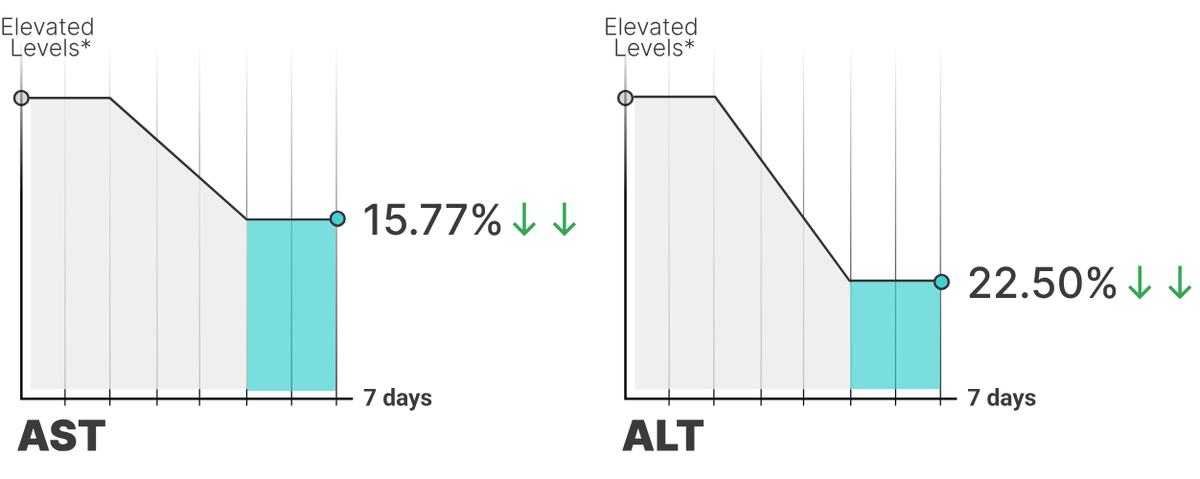
15 subjects · randomized crossover · MFDS approvedLiver enzymes: AST and ALT
AST fell 15.77% and ALT fell 22.50% in the trial’s 15 subjects over 7 days, as reported on The Plug’s Science page, which lists normal levels as ≤40 U/L.
Frequently Asked Questions
What Is a Normal Bilirubin Level?
Is a Bilirubin Level of 1.6 High?
It's just above many labs' upper limit of about 1.2 to 1.3 mg/dL, so it's mildly high. A slightly high total with otherwise normal results is often explained by Gilbert syndrome, especially if the test came after fasting, dehydration or a recent illness (4). Strenuous exercise and some medicines can also nudge results up (1). Your provider will look at the direct and indirect split and the rest of your panel to decide whether to retest.
What Is the Difference Between Direct and Indirect Bilirubin?
Indirect (unconjugated) bilirubin is on its way to the liver and travels bound to albumin. Direct (conjugated) bilirubin has been processed by the liver and made water-soluble so it can leave in bile (2). Which one is high helps point to whether the issue is red blood cell breakdown, liver processing or bile flow.
Can Fasting or Dehydration Raise Bilirubin?
In people with Gilbert syndrome, yes. Their bilirubin tends to rise during dehydration, long periods without food, illness, vigorous exercise or menstruation (4). Strenuous exercise, certain foods and some medicines can also nudge results up in general (1). Tell your provider about any of these before a retest.
What Is the Pathway From Heme to Bilirubin?
The bottom line
Long story short: bilirubin is the yellow leftover from recycling old red blood cells, and your liver's job is to convert it and send it out in bile. A typical adult total runs around 0.1 to 1.2 mg/dL, and the direct and indirect split tells your provider which step of the process slowed down.
A slightly high number is common and often harmless, especially with Gilbert syndrome, where fasting, illness or hard exercise can tip it up. If you notice jaundice, darker urine or lighter stools, or your number keeps climbing, book a prompt visit. Either way, read it alongside the rest of your liver panel with your provider, not on its own at midnight.
Here's to fewer scary-looking portal notifications, PlugFAM. Ask the question, get the context, and keep looking after the organ that handles this cleanup every single day.
Sources
- MedlinePlus. Bilirubin Blood Test. medlineplus.gov
- Cleveland Clinic. Bilirubin Test: Understanding High vs. Low Levels and Causes. my.clevelandclinic.org
- Merck Manual Consumer Version. Jaundice in Adults. www.merckmanuals.com
- MedlinePlus Genetics. Gilbert Syndrome. medlineplus.gov
- MedlinePlus Medical Encyclopedia. Bilirubin Blood Test. medlineplus.gov
- MedlinePlus. Liver Function Tests. medlineplus.gov
These statements have not been evaluated by the Food and Drug Administration. The Plug products are not intended to diagnose, treat, cure or prevent any disease. This article is for general education and is not medical advice. Talk to your healthcare provider about your own lab results, especially if you notice yellowing skin or eyes, dark urine or pale stools.
 NewsWhere Is Your Liver? Location, Size and Liver Pain
 Recovery & HydrationHow and When to Take a Liver Support Drink
 Digestion & GutWhat to Drink After a Meal to Help Digestion